
Marine Research & Ocean Climate Change [2024.H1]
We hand-curate open-access research on marine biology, coral conservation, and the warming oceans. Updated weekly, so you can stay informed on news and research published worldwide.
Start with our 💡Climate Intro for international resources on global warming and coral bleaching.
You can 🔎 SEARCH our links database, and browse the best climate graphics & charts 📈
Alternatively, jump to our Science page for Reefscapers own published research.
💡Introduction
🗓️2024-1 🗓️2024-2 🗓️2025-1 🗓️2025-2 🗓️2026-1 🗓️2026-2
🔎 Search links 📈 Image Archive


Earth Heat Accumulation [berkeleyearth]
Earth Heat Accumulation [berkeleyearth]

Land and Ocean temps (1850-2023) [berkeleyearth]
Land and Ocean temps (1850-2023) [berkeleyearth]

Ocean SST (1860-2020) [berkeleyearth]
Ocean SST (1860-2020) [berkeleyearth]

Ocean temps (1990-2023) [berkeleyearth]
Ocean temps (1990-2023) [berkeleyearth]

New Record Ocean Temperatures – Cheng et al (2024) regional upper 2000m
New Record Ocean Temperatures – Cheng (2024) upper 2000m

Daily SST Tropics [arctic-news climatereanalyzer]
Daily SST Tropics [climatereanalyzer]

2024.03 CMIP6 Climate models v actual SST (1970+) [@hausfath]
Climate models have been accurately forecasting actual SST (1970+) [@hausfath]
- Acropora cervicornis: Spawning Asynchrony, Light & Temperature (Florida, PDF)
- Assessment of warm-water coral reef tipping point thresholds [PDF]
- Belize begins assessment of ‘worst coral bleaching event in a decade’
- Bleaching & recovery following a decade of successive marine heatwaves
- Clownfish may be capable of simple math
- Coral Growth Media: Coconut Shells v Concrete (Indonesia PDF)
- Coral resilience in the face of climate change (Hawaii)
- Coral Restoration: Comparisons in Space, Time, Impact, Cost [PDF]
- Counting Nemo: Amphiprion ocellaris identify their species
- Cross-ocean transplantation to restore resilience of Caribbean reefs
- Cubipod structures: placement grids (breakwaters & shore protection)
- Free online course – Coral Reefs: Introduction to Challenges and Solutions
- Giving hermit crabs new homes (Dodo video)
- Microplastics in coral ecosystems: threat needs more global attention
- Microplastics: Systematic Review, Detection, Removal
- NOAA: Coral Infographics Gallery
- Reef fish abundance enhancement via reef restoration (Malaysia PDF)
- Reef fish resilience following … coral bleaching (GBR PDF)
- Reef Restoration Field Photogrammetry in 4D (08.2023 PDF)
- Reef Restoration: impacts of materials on coral bacteria
- Restoration of endangered Acropora palmata (Florida)
- Site Selection: Stony Coral Microfragment Outplant Success [PDF]
- Stony coral tissue loss disease: a review (etiology, diagnostics, etc)
- The race to build climate-resilient coral reefs (BBC)
- Variability of the surface boundary layer of reef-building coral species
- Within-reef variability in coral dynamics: modelling framework [PDF]
- Zooplankton fecal pellets: Sinking and carbon [PDF]
- 🔥 Berkeley Earth: Global Temperature Report for 2023
- 🔥 CarbonBrief: State of the Climate: 2023
- 🔥CODE BLUE: OUR OCEANS IN CRISIS - excellent illustrated report by Australia's Climate Council [PDF]
- APCC/APEC: Climate Outlook (Feb-July 2024)
- AXIOS: Global temperatures near the 1.5-degree target in 2023
- BBC: 2023 confirmed as world’s hottest year on record
- Climate Change: Migration & Sustainability of Atoll Islands [PDF] - Jarillo et al (2024)
- CO2 emissions and ocean acidification from bottom-trawling
- Deep-Ocean Warming: Coastal Sea Level Trends (Mexico)
- Fishing: ‘Bottom Trawling’ Releases CO2
- Historical and future maximum sea surface temperatures
- Multiyear prediction: marine habitat shifts constrained by ocean temperature and dissolved oxygen
- NASA Analysis Confirms 2023 as Warmest Year on Record
- NATURE: Oceans break heat records five years in a row
- NATURE: Robust acceleration of Earth system heating over six decades
- Ocean Heat Transport and Surface Heat Fluxes: Driving Arctic Ocean Warming and Sea Ice Decline
- Projected amplification of summer marine heatwaves in a warming Northeast Pacific Ocean
- Twitter: Super El Nino prediction for 2024
- “I wasn’t worried about climate change. Now I am” – Dr Sabine Hossenfelder

Stony coral tissue loss disease – Papke et al (2024)

Global SST (1950-2030) models all [carbonbrief]
Global SST (1950-2030) models [carbonbrief]

Monthly global ocean heat content (1950s-2020s) [carbonbrief]
Global ocean heat Monthly (1950s-2020s) [carbonbrief]

Annual global ocean heat content (1950-2023) [carbonbrief]
Global ocean heat Annual (1950-2023) [carbonbrief]
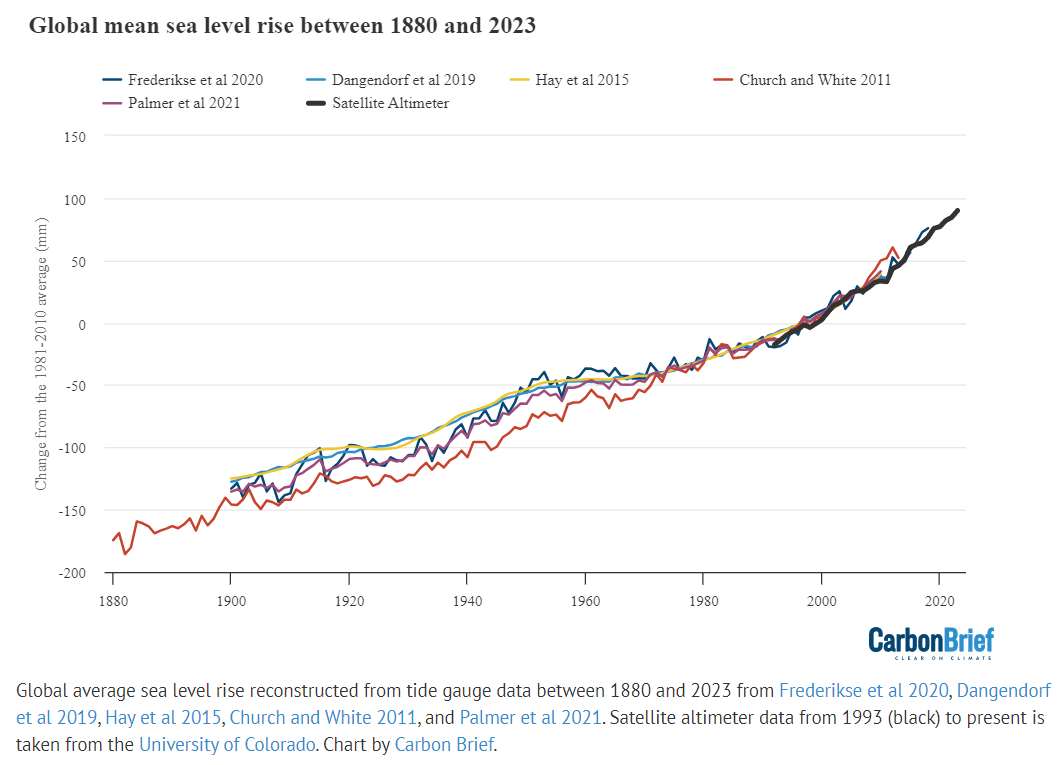
Global mean sea level rise (1880-2023) [carbonbrief]
Global mean sea level rise (1880-2023) [carbonbrief]
Coral Bleaching in the Chagos Islands
Located in the Indian Ocean, 500km to the south of the Maldives, the Chagos Archipelago comprises 7 geographic atolls and 60+ islands. In previous years, the Chagos reefs have been damaged by coral bleaching events, caused by increasingly elevated global ocean temperatures.
Looking at the ‘Country Comparisons’ image below, we can see the SSTs for Chagos tend to warm one month sooner than in the Maldives, as expected given the relative locations and the warmer currents that head northwards. For the mass coral bleaching events:
- 1998 – Similar severity, with Chagos at alert level #1 (April-May), and Maldives at level #1-2 (May-June). The recorded SSTs and DHW are similar for both.
- 2016 – Chagos experienced higher temperatures (and in 2015 too). Alert level #1-2 peaked from mid-March to mid-June, with DHW reaching 18 weeks, causing major coral bleaching and mortality. The Maldives peaked briefly at level #1-2 from mid-April to mid-May, totalling 11 DHW that we know was very damaging for Maldivian reefs.
- 2024 – Chagos hit level #1 mid-March, and temperatures continue to rise as at 02 April (7 DHW). Therefore, we might expect the Maldives to reach level #1 by mid-April, 1 month later. This year, the Indian Ocean temperatures will likely be further boosted by both El Nino and the positive IOD.
Shepherd et al (2017) describes ‘Coral Bleaching and Mortality in the Chagos Archipelago’ from the global mass bleaching event of 2016. Coral cover was being measured for 20+ years, and after the 2016 bleaching, mortality was very severe and coral cover declined from the ~30-50% range, down to just 5-10%. (Most atolls are uninhabited, so any changes are driven by climate change rather than by local anthropogenic effects).
Local water temperatures increased by 0.3C (ocean reefs) to 0.5C (lagoons) in just 10 years. Numbers of juvenile corals severely declined, suggesting that future recurrences of mass mortalities will occur too frequently for reef recovery as soon as 2029.
Carlton et al (2021) wrote the Chagos Archipelago Final Report as part of a Global Reef Expedition [PDF], from their 2 month assessment of Chagos reefs in 2015 (completed just as the reefs started to bleach). In an interesting follow-up article in 2021, team-member Prof Sam Purkis describes ‘Watching a coral reef die as climate change devastates one of the most pristine tropical island areas on Earth. It wasn’t just small pieces of the reef that were bleaching – it was happening across hundreds of square miles. We were witnessing the death of a reef’.
‘The Chagos reefs could potentially recover – if they are spared from more heat waves. Even a 10% recovery would make the reefs stronger for when the next bleaching occurs. But recovery of a reef is measured in decades, not years. So far, research missions that have returned to the Chagos reefs have found only meager recovery, if any at all.’
Diaz et al (2023) describes ‘Mesophotic coral bleaching associated with changes in thermocline depth’ during field work conducted in 2019-2020. They found coral bleaching at depths of 90m, despite the absence of shallow-water bleaching. The 90m bleaching was associated with sustained thermocline deepening driven by the Indian Ocean Dipole (described above).
As global temperatures continue to rise, shallow coral reef bleaching has become more intense and widespread. Mesophotic coral ecosystems reside in cooler, deeper water (30–150m) and were thought to offer a refuge to shallow-water reefs. But studies now show that deeper ecosystems host diverse endemic communities with limited connectivity to shallow corals.
Chagos: start of coral bleaching (Feb 2024) seen at 60-90m depth, thanks to @Clara_Diaz_974 >

Chagos MAP
Chagos MAP

Chagos Coral bleaching (Jan-Feb 2024) 60-90m deep [@Clara_Diaz_974]
Chagos Coral bleaching (Jan-Feb 2024) 60-90m deep [@Clara_Diaz_974]

Chagos Coral bleaching (Jan-Feb 2024) 60-90m deep [@Clara_Diaz_974]-2
Chagos Coral bleaching (Jan-Feb 2024) 60-90m deep [@Clara_Diaz_974]

SST DHW GBR & CHAGOS & MV bleach years [02-Apr-24]
SST & DHW: comparison of GBR, Chagos, MV (mass bleach years). Reefscapers infographic (NOAA data)

FT: Global SST reached a record January high of 20.97°C (second-hottest month ever, after August 2023 at 20.98°C).
SSTs have already reached “new absolute records”, with 21.12°C on 4 February 2024.

Global SST anomalies [16-Feb-24]
Global SST anomalies [16-Feb-24]

Global SST anomalies MAP
Global SST anomalies MAP

SST Climatology Indo-Pacific (1900-1980-2022) Samanta et al (2024)
SST Indo-Pacific (1900-2022) Samanta et al (2024)

MSU troposphere temp anomalies (1980-2024)
MSU troposphere temp anomalies (1980-2024) @RogerCoppock
- Adaptation of sea turtles to climate warming : Will phenological responses counteract changes in reproductive output? (2023)
- Adaptation to climate change: Fuvahmulah, Maldives
- After mass coral die-off, Florida scientists rethink plan to save ailing reefs
- Benthic habitat assessments on coral reefs: direct field measurements v remote sensing
- Bycatch of Sharks: Technical Mitigation Techniques for Reduction - Drynan & Baker (2024) CMS
- Coral Restoration in Palk Bay (India, PDF)
- Coral Tissue Regeneration: Stem-like Cells
- Diversity of Chaetodontidae (Butterflyfish) and Relationship With Corals (Indonesia, PDF)
- Environmental monitoring of foraminiferal distribution (Lakshadweep)
- Fish biogeographic ranges under ocean warming - Hayes et al (2024)
- Functions on coral reefs: past, current and future potential - Bellwood et al (2024) Coral Reefs
- GBR suffers ‘extensive’ coral bleaching [CNN] - scientists fear seventh mass bleaching event
- GBR: Extensive coral bleaching (29-Feb-24) - video by James Cook University, Australian Institute of Marine Science.
- Global areas for coral reefs from satellite mapping
- Great Barrier Reef Aerial Surveys: Bleaching (28-Feb-24) - press release by The GBR Marine Park Authority
- Green turtles & seagrass: habitat management (Au, PDF)
- Hawksbill turtles on the seabed (60m deep): feeding habits - Remote submerged banks provide habitat (Chagos)
- Heat Tolerant Corals for Reef Restoration [PDF]
- Herbivory across Pacific coral reefs [PDF]
- How much sediment is supplied to coral islands from the reef system? - Scientists provide first detailed estimates (Maldives) : Meta-Study
- Impacts of heatwave & disturbance on juvenile corals [PDF]
- Mantas: population & habitat in Seychelles
- Mapping new global coral reef areas (Lyons et al) [PDF]
- Microbial community of coral reefs : biofilm composition on artificial substrates under different environmental conditions
- Microplastic exposure on Pocillopora damicornis
- Pocilloporid corals in the warming oceans of Australia
- Reef restoration: benthic recruitment processes [PDF]
- Review: Climatic Threats and Adaptation of Marine Biodiversity
- Securing Coral Reefs: Sustainable Development Goals
- Shifting reef restoration focus from coral survivorship to biodiversity using “Reef Carpets”
- Sponge-derived matter is assimilated by coral holobionts - a recycling pathway that could improve coral aquaculture
- Sponges on living Scleractinian corals (Indonesia) [PDF]
- The evolving relationship between humans and sharks (PDF)
- The world has warmed 1.5 °C, according to 300-year-old sponges
- Transects in coral cover: motion photogrammetry - Wang et al (2024)
- Tuna fishing: Interactions with Endangered species (Maldives) [PDF]
- 🔥 Berkeley Earth: January 2024 Updates - published 27 Feb 2024
- AMOC: Atlantic circulation nearing ‘devastating’ tipping point
- AMOC: Atlantic headed for a tipping point − when melting glaciers shut down Gulf Stream, we will see extreme climate change in decades.
- AMOC: Hysteresis in New Global Climate Model
- AMOC: Physics-based early warning shows tipping course
- Atmosphere and ocean energy transport in extreme warming scenarios
- Breeding Corals Resilient to Global Warming - K.M. Quigley [Annual Review]
- Climate adaptation (Maldives): long-term response of coral islands to sea level rise
- Copernicus C3S Seasonal forecast EU (10-Feb) - El Niño has peaked; by mid-year, La Niña more likely.
- Copernicus Interactive Climate Tools - C3S Atlas - and - Pulse
- El Niño: future clues are preserved in ancient reefs
- February 2024 ENSO Outlook - All along the La Niña WATCH-tower
- FT: Critical 1.5C threshold breached (Global SSTs reach record highs)
- IAPv4 Ocean Temperature and Ocean Heat - confirmation of warming acceleration (Cheng et al 2024)
- Indian Ocean Seasonal SST in CMIP6 Models - understanding biases
- Multi-Century Projections of Sea Level Rise
- NOAA Coral Reef Watch extends alert scale following extreme coral heat stress in 2023
- Ocean circulation pathways reshape the Indian Ocean oxygen minimum zone with warming
- Ocean mass observations & sea level rise - increase by ice wastage & water management.
- Sea Surface Temp Visualization (new tool) - daily worldwide SST datasets downloaded & visualized (daily world map, annual graph)
- Seagrass: Rapid sea level rise causes loss of meadows - Capistrant-Fossa & Dunton (2024)
- Sensitivity of Ocean Heat Content to Instrumental Platforms - Lijung Cheng (2024)
- Socioeconomic Ramifications of Sea Level Rise in the Maldives : A Holistic Assessment of Impacts and Adaptation Strategies
- YALE: How to speak with friends about environmental issues - biodiversity loss & climate change. Also: prebunk, not debunk.

NOAA Coral Reef Watch: 4-Month Coral Bleaching Outlook
Forecast animation (22-Feb), for the period: 25-Feb to 07-Jul 2024

NOAA temperature percentiles Feb24
NOAA temperature percentiles Feb24

Record DHW on Great Barrier Reef (29 Feb 24) [climatereanalyzer]
2024 record DHW on Great Barrier Reef [black lines] (29-Feb-24)

SST 1998 2016 2023-24 C3S (Copernicus Climate Change Service)
SST: mass coral bleach years [Copernicus C3S] (29-Feb-24)

IAPv4 annual ocean heating rates (Cheng et al 2024)
IAPv4 annual ocean heating rates (Cheng et al 2024)
How could the Indian Ocean Dipole (IOD) affect Maldivian corals in 2024 ?
The Indian Ocean Dipole (IOD) (“Indian Niño”) is an irregular oscillation of SSTs in which the western Indian Ocean becomes alternately warmer (positive phase) and then colder (negative phase) than the eastern part of the ocean. The IOD was first identified by climate researchers in 1999, with coral records (2008) dating back to 1846. There is an average of 4 positive-negative IOD oscillations each 30-years, with each event lasting 6 months. Recent decades show increasing irregularity due to climate change. In addition, an IOD-ENSO interaction contributes to the generation of Super El Niños.
Current forecasts from Australia’s BOM are predicting a positive phase for the Indian Ocean Dipole in 2024. This will likely raise the ocean temperatures around the Maldives, in addition to the El Niño warming event. The IOD might also bring increased rainfall with the arrival of the SW monsoon (late April-May), but this anticipated cooling effect may be too late to significantly help the corals, as initial bleaching effects are already being reported on some Maldivian reefs (photos, below).


NOAA Indian Ocean Dipole POSITIVE phase explained
Indian Ocean Dipole POSITIVE phase [NOAA] explanation

2024.03 IOD Index weekly 2020-24 (22Mar24) [bom.gov.au]
IOD Index RECORDED 2020-24 (22Mar24) [bom.gov.au]

2024.03 IOD forecast Apr-Aug 2024 (16Mar24) [bom.gov.au]
IOD Apr-Aug 2024 FORECAST (16Mar24) [bom.gov.au]

2024.03 IOD Index Time Series 2024 (17Mar24) [bom.gov.au]
IOD Index Time Series 2024 (17Mar24) [bom.gov.au]


Reefscapers infographic using NOAA forecast tools [click to enlarge]
SST & DHW in Australia (GBR) & Maldives, bleachings 1998 & 2016.
As GBR bleaches in Feb-Mar, before MV (Apr-May), we can use the severity of GBR bleaching to try to predict effects in MV in 2024.

NOAA: 5km Regional Bleaching Heat Stress Maps and Gauges
In the upcoming weeks, the Maldives is forecast to experence high ocean temperatures (CoralWatch Alert Level #2).
- 🌱 Mangroves of the Maldives: distribution & diversity - Cerri et al (2024) Aquat Sci
- 🔉 Interview: Prof Terry Hughes on GBR coral bleaching - ABC News (Aus) audio recorded 08-Feb-24
- 4,000+ plastic chemicals are hazardous - persistent, bioaccumulative, mobile, toxic - extensive new research report by PlastChem
- Biodiversity and biogeography of zooxanthellate corals - Richards et al (2024) - 438 coral species, Australasia - twitter photos: @ZoeR_Coral
- Bleaching reduces reproductive output in Acropora millepora - Briggs et al (2024) Coral Reefs
- Caribbean Corals: 6 Months Later
- Citizen science: tracking abundance of marine fish
- Coral Bleaching in South Huvadhu Atoll, Maldives - twitter photos @nixams8 & @MaldivesCoral
- Coral Reef Restoration: Environmental & Climatic Considerations - Burdett et al (2024)
- articles: Tomorrow's Reefs - and - Restoring Reefs
- Coral reefs: Ecology-social resilience (Indonesia)
- Coral Restoration Drives Reef Carbonate Budget Recovery - Lange et al (2024.03) Current Biology
- Coral’s synergistic response to climate stressors - Dilworth et al (2024)
- Corals in a warming hotspot: demographic shifts & disturbance responses - Sommer et al (2024) Sci Rep
- CoralWatch: Coral Bleaching at Point Vernon (GBR) (twitter video)
- Deep-freezing corals to repopulate future oceans
- Deoxygenation triggers mass coral mortality (2022) - following coral spawning and thermal stress (Ningaloo Reef, AU) - Richards et al (2024)
- Depth variation: benthic community response to repeated marine heatwaves (Chagos) - 25m is not safe
- Detection of human pharmaceuticals in soft corals (Maldives) - Becchi et al (2024) Chemosphere
- First Nations: Marine Genetic Conservation - Quigley et al (2024)
- Fish Migrating to Poles to Escape Warming Waters
- Future oceans: genomic forecasting in marine species - Layton et al (2024)
- GBR (north): latest bleaching photos (19 Mar) Mass mortality: 8km of reef is now >80% bleached/dead after ~6 DHW - @JezRoff
- GBR bleaching is 5th in 8 summers – the corals now have almost no reprieve (by Prof Terry Hughes)
- GBR Mass Bleaching of 200yo Corals (ABC 14 Mar) - and video
- GBR: Cognitive dissonance with mass coral bleaching
- GBR: Coral bleaching in Far North - James Cook Uni
- GBR: Coral Bleaching Video (uploaded 15 Mar) - on Instagram - by Yolanda Waters, @ausconservation & @theundertowmedia.ocean
- GBR: Guides Face Up To Bleaching Tragedy - ‘Tourists ask a lot of questions’ (22 Mar)
- GBR: Lord Howe island ‘major’ coral bleaching
- GBR: Mass coral bleaching extends to SE Queensland (16 Mar)
- GBR: Tourism-led coral-planting [PDF]
- GBR: Underwater Bushfire (14 Mar)
- Genomics of a novel ecological phase shift: the case of a ‘weedy’ Montipora coral - Bernardi et al (2024) Coral Reefs
- Gluts of Ghost Gear - staggering amounts of fishing gear discarded
- Good fisheries management is good carbon management - overfishing disrupts the marine vertebrates carbon cycle and damages the seabed.
- Increasing hypoxia in coastal ocean (US Pacific NW)
- Maldives Pole-and-Line Skipjack Tuna Fishery [PDF] Marine Stewardship Council, Indian Ocean: Lessons of Sustainability (in Fishing)
- Maldives: Coral Bleaching Alert Issued
- Marine heatwaves disrupt ecosystem food webs & energy flux - Gomes et al (2024) Nat Commun
- Marine protected areas to rebuild fish stocks
- Marine Protected Areas: Economic Benefits (paper review) - Costello (2024) Sci. mar.
- Millepora Returns After 1998 Mortality (Maldives) in deeper waters of 7–13m - Pancrazi et al (2024) Diversity
- Monitoring, Assessing & Managing Large Marine Ecosystems [PDF]
- One in Seven Deepwater Sharks and Rays Threatened With Extinction
- Population genetics & oceanographic models: strong connectivity among coral reefs (Seychelles) - Burt et al (2024) - one million square kilometre 'Coral Superhighway' (12 Mar, BBC)
- Response of 2 scleractinian corals to ocean warming
- Restoration: poor long-term survival of Acropora cervicornis [PDF]
- Rethinking atoll futures: local resilience to global challenges - Steibl et al (2024) - the geophysical processes that control atoll island accretion are being impacted on global and local scales.
- Sea anemone: prey capture & predation when bleached (Exaiptasia diaphana)
- Sea Turtle Foraging Grounds: global thermal vulnerability - Goudarzi et al (2024)
- Seabirds from the poles: microplastics pollution sentinels - Taurozzi & Scalici (2024.03) Sec. Marine Pollution
- Seabirds in Arctic: 97% have ingested microplastics
- Six Months On, Caribbean Corals Are Still Reeling
- Threats and Impacts to the Seascape of Mauritius [PDF]
- WaPo: Fatal heat wave strikes unspoiled GBR archived link
- World on brink of fourth mass coral reef bleaching event - Reuters exclusive: "entirety of Southern Hemisphere is probably going to bleach".
- 🔥 Berkeley Earth: February 2024 Temperature Update
- 🔥 Copernicus: Feb 2024 was warmest on record - SST 21.06°C, higher than previous record of 20.98°C (Aug-23).
- 🔥 IPCC Climate Change Explainer: (1) Science - four infographics -
(2) Mitigation (3) Adaptation (4) Synthesis
- 365 Days of Record Ocean Temperatures (14 Mar 2024)
- AMOC: Are we breaking the Atlantic Ocean? (Vox)
- AMOC: intermediate tipping of Atlantic Ocean circulation
- Antarctic sea ice near historic lows
- Antarctic sea ice ‘behaving strangely’
- Antarctic sea ice: Growing fears of an alarming shift
- Arctic Ocean Projections: ice-free summers - major changes expected within a decade.
- Carbon sequestration as a climate ‘solution’
- Climate Change: Evolutionary dynamics of island shorelines [PDF]
- Climate models can’t explain 2023’s huge heat anomaly — we could be in uncharted territory
- Climate scientist: ‘If you knew what I know, you’d be terrified too’
- EEA Report No 1/2024 (11 March) - EU climate impacts & risks (IPCC, Copernicus, +)
- Enhanced CO2 uptake of the coastal ocean is dominated by biological carbon fixation - Mathis et al (2024) Nat. Clim. Chang
- Fighting Misinformation - Nadia M. Brashier (2024)
- FT: World is warming faster than scientists expected
- Global Ocean Mass Increase: Tide Gauges + Climate Models
- Historical Sea Level Change in Indo-Pacific
- How the climate crisis affects our brains
- Is the record heat now accelerating?
- Longer-Term Climate Change: Ocean Temperature and Sea Ice Extremes
- NOAA: Global climate report Feb 24 - pub 21 March - full report
- Sea Level Rise and Storm Tide Alter Coastal Water Levels : How and Why?
- Sea Level Spike Due to El Niño (NASA) - Global average sea level rose by 0.76cm from 2022-23 - Vital Signs
- Sea Levels & Increased Wave Energy - American Samoa
- SST from Ocean Modelling: coral heat stress predictions (Hawaii)
- SST Pattern Effects - Climate models are unable to reproduce recent observed warming; major uncertainties in future projections.
- SST research: Clear evidence of human-caused climate change
- The Oceans We Knew Are Already Gone - transformation of our seas is “effectively permanent” [archive link]
- Viability and risks: marine cloud brightening
- WMO: State of the Global Climate 2023 - major report - PDF

Update: Great Barrier Reef (Central) starts to cool.
SST falls below bleaching threshold, and record DHW starts to plateau
(from 1 to 11 March 2024).
Reefscapers animation using NOAA’s GBR Time Series Graphs

Global SST Anomaly (1982 to Mar 2024) [@EliotJacobson]

Copernicus SST percentiles Feb 2024 global map
Copernicus: Global SST for Feb24 (new record 21.06°C)

12 continuous months of record global SST, Mar 2023-24
12 continuous months of record global SST, Mar 2023-24

Global mean sea level rise (1900-2150)
Global mean sea level rise, multi-century (1900-2150)

NASA: Sea Level Rise (satellite stats)
NASA: Sea Level Rise (satellite stats)
 Seychelles Bleaching (March 2024)
A good example of the vulnerability of fast-growing Acropora corals to repeated marine heatwave events.
Thanks to Charlotte Dale


 Brazil’s marine protected area (MPA Costa dos Corais) Coral Bleaching March-April 2024


 GBR Extensive Coral Bleaching across the entire reef, North to South (March 2024)
Thanks to: @ProfTerryHughes, @JezRoff, @DrCarlyRandall, Amy ‘intheocean’ Lawson, @johnwturnbull (& flickr),
plus ABC, The Guardian, and The Undertow.


GBR Healthy reef (2023) now bleached (Mar 2024): Before & After (slider) – striking aerial photos taken at the same location
Thanks to Prof Michael Sweet FRSB, @coralseafound, @JezRoff


- AFP Factcheck: Coral reef misinformation
- Brazil braces for worst coral bleaching ever - Reuters (18 April)
- Butterflyfish: A Guide [PDF] - Ismail & Goeden (2024)
- Cnidarians: predation upon large animals (review) - Gregorin et al (2024) Hydrobiologia
- Coastal Flood Hazard Assessment for Tuvalu - Wandres et al (2024) Earth's Future
- Coastal Restoration: Small Island States in the Face of Sea Level Rise - Hernández-Delgado (2024) Coasts
- Coral aquaculture: Low light intensity increased survival of early recruits (spat) - Ramsby et al (2024) Coral Reefs
- Coral Reefs Face a Deadly Mass Bleaching - interview with Prof Terry Hughes - by Meghan Bartels (17 Apr) SciAm
- Coral-seeding devices: fish-exclusion reduces mortality - Whitman et al (2024)
- Corals survive severe bleaching: taxa, colony size, water depth - Winslow et al (2024) Sci Rep
- Crown-of-thorns seastar (Acanthaster) feeding ecology - Foo et al (2024)
- Deep-sea expedition captures stunning images
- Earth’s Coral Reefs Face Deadly Mass Bleaching - Sci Am (17 Apr)
- Extreme heat in 2023: drastic slump in marine life (New Sci) - Decline in ocean net primary production - Bowles et al (2024 preprint)
- Floating Artificial Island: solar energy for coral recovery (VietNam) - Lê Thanh Tài (2024) pre-print
- GBR Climatic factors: main drivers of coral bleaching (ARC) - PDF
- GBR is ‘transforming’ from repeated coral bleaching
- GBR MPA: Reef snapshot summer 2023-24
- GBR Orthomosaic (19 March): coral bleaching at Lizard Island - George Roff
- GBR: 75% of reefs have been affected [10 News] - twitter video @10NewsFirstQLD (07 Apr)
- GBR: Corals can bounce back after heatwaves – but only if there’s enough time between them
- GBR: Reef Health Updates (05 Apr) - Reef status: 25% healthy, 60% high+ bleaching. (SSTs remain +0.5-1.5C)
- GBR: the unseen casualties of record-breaking heat
- GBR: Underwater Resources at Lizard Island (AFP)
- GBR: Unprecedented spread of coral bleaching - “It’s alarming how extensive and severe this current coral bleaching event is” - Herald (06 Apr)
- GBR: ‘most severe’ coral bleaching on record - and video
- GIANT CORALS: share your sightings (Maldives)
- Global database: coral recovery following marine heatwaves
- Global heating pushes coral reefs towards worst planet-wide mass bleaching on record
- Global Warming: Atlantic species to colonize the Mediterranean
- Habitat Use of Loggerhead & Green Turtles (NW Pacific) - Caretta caretta & Chelonia mydas - Kim et al (2024) PLoS ONE
- Impacts of ocean warming & acidification on marine animals (meta-analysis) - Alter et al (2024) Nat Commun
- Increased suspended sediments near global river deltas - Hou et al (2024) Nat Commun
- Increasing frequency of deadly ocean upwells - Climate change-driven cooling kills marine megafauna - Lubitz et al (2024) Nat Clim Change.
- Manta Ray cleaning station zooplankton community (Indonesia) - Widiastuti & Borumei (2024) Biodiversitas
- Morphologically driven sedimentation patterns on a coral reef - Sartori et al (preprint 2024) Research Square
- Nanotechnology to restore reef biodiversity - ‘Cities under the sea’
- NOAA confirms 4th global coral bleaching event
- NOAA: 4th Global Coral Bleaching Event Underway - BBC (15 Apr)
- Plastic Pollution: Global producer responsibility - Cowger et al (2024)
- Probiotics reshape the coral microbiome in situ - Delgadillo-Ordoñez et al (2024) Commun Biol
- RADReef: A global Holocene Reef Rate of Accretion Dataset - Hynes et al (2024) Sci Data
- Reef manta rays (Mobula alfredi): Spatial connectivity (Indonesia) - Setyawan wt al (2024) Soc Open Sci
- Reef restoration structures: coral-associated bacteria Strudwick et al (2024) Front. Mar. Sci.
- ReScape: Transforming coral-reefscape images for quantitative analysis - Ferris et al (2024) Sci Rep
- Resilience to periodic disturbances in Acropora - Thomas et al (2024) Commun Biol
- Restoration as a meaningful aid to ecological recovery of coral reefs - Suggett et al (2024)
- Sea Ice in 2023 (review) Roach & Meier (2024) Nat Rev Earth Environ
- Sea turtle nests under threat (Australia) - flatback (Natator depressus)
- Seagrass Monitoring: AI-driven remote sensing (Mediterranean) - Chowdhury et al (2024)
- Warming seas push India’s fishers into distant, dangerous waters
- Zero coral recovery, three years after major bleaching event (SW Atlantic) - Corazza et al (2024) Mar Biol
- 🔥 AMOC: Is the Atlantic Approaching a Tipping Point? - Prof Stefan Rahmstorf (10 Apr 24)
- 🔥 Ocean Heat Content in 2023 - Rate of ocean warming could be 39% higher than climate scenarios (CERES vs SSP ranges) - Cheng et al (2024) Nat Rev Earth Environ
- 🔥 The Maldives is racing to create new land. Why are so many people concerned? - Jesse Chase-Lubitz (Nature, 24 Apr 2024) -- excellent photostory
- Antarctic: ‘Mind-boggling’ Temperatures Jump +38.5C
- Copernicus: Record Temperatures for April 2024
- Doughnut Economics: A good life for all *is* possible within planetary boundaries - Schlesier et al (2024)
- Earth at risk: Urgent call to end destruction for a sustainable future - Fletcher et al (2024) PNAS Nexus
- Factcheck: the recent acceleration in global warming is what scientists expect
- Heatwaves and extreme sea levels increasing - Zhou & Wang (2024)
- Indian Ocean Dipole (IOD): Decreased variability under prolonged greenhouse warming Kim et al (2024) Nat Commun
- NASA: PACE Ocean Data Tools & Color Images - now available to the public
- Ocean Warming: Intensification of Tropical Cyclones (Bay of Bengal, India) Ray et al (2024)
- Recent reductions in aerosol emissions have increased Earth’s energy imbalance - Hodnebrog et al (2024) Nature
- Regional SST: global warming (CMIP6) - Milovac et al (2024) Clim Dyn
- Responses of marine trophic levels to the combined effects of ocean acidification and warming - Hu et al (2024) Nat Commun
- Substantial cooling effect from aerosol-induced increase in tropical marine cloud cover - Chen et al (2024) Nat Geosci
- Surface Ocean CO2 and Air-Sea Fluxes - Chau et al (2024)
- The Indian Ocean and its Role in the Global Climate System - Ed: Ummenhofer & Hood, 1st Edition (April 2024) eBook ISBN: 9780128232866
- Why ocean temperatures keep smashing records

SST 1998 2016 2023-24 [C3S]

SST Anomaly 1998 2016 2023-24 [C3S]
GBR Mass coral bleaching event update (9 April 2024): Preliminary analysis by CoralWatch team’s @JezRoff
– Satellite data for degree heating weeks (DHW) clearly outline the record intensity and impact.
– 46% of reefs experienced record high DHW.
– New record of 17.7 DHW from southern GBR.
– 37% of GBR has been exposed to three or more >6DHW events in the past decade.
– Mass bleaching events are increasing in frequency and intensity since 1986.
– 31% of the southern “refugia” reefs have been exposed to >4DHW for the first time in over three decades.
– High (4-8 DHW) and severe (8-12 DHW) exposure categories are becoming commonplace.
– The intensification from the first event (1998) through to 2024 is striking.
– Sustained high DHW across much of the reef => predicted high mortality.
– Despite temperatures dropping, many reefs (eg: Heron Island) continue to experience sustained record DHW exposure.
– Awaiting results of in-water surveys
– AIMS PDF (15 Apr): Aerial surveys of the 2024 mass coral bleaching event on the Great Barrier Reef

GBR record DHW satellite data 2024) [@JezRoff]
GBR record DHW satellite data 2024) [@JezRoff]

GBR record DHW (1998-2024) [@JezRoff]
GBR record DHW (1998-2024) [@JezRoff]

GBR record DHW (1998-2024) compared [@JezRoff]
GBR record DHW (1998-2024) compared [@JezRoff]

GBR Bleaching map 2024 AIMS
GBR Bleaching map 2024 AIMS
PDF (15 April 2024) – AIMS Aerial surveys of the 2024 mass coral bleaching event on the Great Barrier Reef
- AIMS Reef Health Updates > 26 April 2024
- Ocean temperatures started building in late December through to late February throughout all three regions of the Great Barrier Reef, causing the highest levels of thermal stress on record.
- In March 2024, the fifth mass bleaching event on the Great Barrier Reef was confirmed.
- This year for the first time, extreme bleaching (90% bleached coral cover) was observed in all three regions of the GBR.
- 73% of GBR reefs have prevalent bleaching (>10% bleached coral cover).
- 60% of GBR reefs were exposed to dangerous levels of heat stress (bleaching and mortality risk).
- 46% of GBR reefs experienced record levels of heat stress.
- 39% of GBR reefs experienced ‘very high’ to ‘extreme’ (61-90%+ coral cover) levels of bleaching
- GBR’s southern inshore reefs experienced the most intense and prolonged heat stress ever recorded: SST at +2.5°C above average, and 15 degree heating weeks.
- By 26 April, the SSTs across the whole Marine Park had cooled to below the average summer maximum (and below the coral stress threshold) but remain above the long-term April average (by +1°C to +1.5°C).
 Maldives April 2024 – Coral bleaching (South Male’ Atoll)
Night-time ocean temperatures at 10m depth (usually ~28°C) are hitting a staggering 30°C! 🔥 Thanks to 📷 @nixams8
Also: Twitter video showing bleaching at Kottey Bay, Hithadhoo, Addu City [@KhalylKhaleel]


Copernicus: Global Sea Surface Temperature (SST) Anomalies (April 2024)
April 2024 SST (global 60°S–60°N) was 21.04°C, the highest on record for the month, and the 13th consecutive monthly record high.
SSTs broke records across many of the world’s oceans (highlighted as ‘warmest’ colour).
GBR flickr photo album – by – @johnwturnbull


- Actinostella (sea anemone): Revision - Barragán et al (2024)
- Aquaculture: food, climate change, biodiversity - Wong et al (2024) npj Ocean Sustain
- Blue Carbon Ecosystems: It’s time to broaden our understanding - James et al (2024)
- Carbonate and sediment budgets: marginal reef systems - Dee et al (2024) Marine Geology
- Coral reef complexity: cryptobenthic biodiversity (Maldives) - Brodnicke et al (2024)
- Coral reef fish: Timing-specific parental effects of ocean warming - Bonzi et al (2024) Proc. R. Soc. B
- Coral Reef Kaleidoscopes by Georgette Douwma - as featured in Natgeo (May 2024)
- Coral Shoals Detection from Satellite Imagery - Li et al (2024) Mar. Sci. Eng.
- Coral-killing Sponge (Terpios hoshinota): Spicules - Hirose et al (2024)
- Effects of built structures in shallow, tropical coral reefs - Paxton et al (2024) Environ Evid
- Fisheries reach deep, but marine protection remains shallow - Jacquemont et al (2024) Nat Commun
- Florida: The future of coral restoration after unprecedented marine heat wave of 2023 - NOAA (06 May)
- GBR in crisis: scientists despair as corals perish
- GBR’s worst bleaching leaves giant coral graveyard
- GBR: ‘prevalent bleaching – crisis under the water’ - 9NEWS (5 May)
- GBR: ‘Like wildfires underwater’ – Worst summer on record as coral die-off sweeps planet - CNN (4 May)
- Global biogeography of microbes driving ocean ecological status under climate change -Zhang et al (2024) Nat Commun
- Global Decline in the Size of Sea Turtles - Hays et al (2025)
- High rates of erosion on a wave-exposed fringing coral reef - Thomson et al (2024)
- Increasingly Frequent Ocean Heat Waves - Trigger Mass Sealife Die-Offs (and Grief in Marine Scientists)
- Island accretion within a degraded reef ecosystem (Indonesia) - Kappelmann et al (2024) Sedimentary Geology
- Kelp carried to the deep sea stores more carbon
- Lakshadweep: coral bleaching threatens marine ecosystem
- Lakshadweep: Widespread coral bleaching
- Mangrove forests: Half at risk due to human behaviour
- Mangroves: Globally, more than half are at risk of collapse by 2050 - Findings report: Red List of Mangrove Ecosystems (IUCN)
- Mapping emergent coral reefs: pixel- and object-based methods - Stone et al (2024) Wiley
- Mobula birostris x M. alfredi: First Documented Courtship Behavior - Setyawan et al (2024) Diversity
- Naifaru House Reef: coral bleaching video (Lhaviyani Atoll, Maldives) 🇲🇻 - Instagram reel by @atollmarinecentre
- Rehabilitating coral reefs in the Anthropocene - Edwards et al (2024) Current Biology
- Sandy beach erosion: impacts & adaptation (Thailand) - Thepsiriamnuay & Pumijumnong (2024) Environ Dev Sustain
- Sea urchin die-off spreading through the world’s oceans
- Seagrass and Carbon Storage (W.Aus) - ABC News
- Seagrass meadow expansion in Indian Ocean bright spot (Maldives) - Floyd et al (2024) Sci Rep
- Seagrass meadows are rapidly expanding (Maldives) - Matthew Floyd discusses his new paper
- Shortfin devil ray (Mobula kuhlii): Behavior and demographics - Carpenter et al (2024) Mar Biol
- Stony coral tissue loss disease indirectly alters reef communities - Swaminathan et al (2024) Sci. Adv.
- Thai sea temperatures hit new record: mass coral bleaching (Reuters)
- The Fourth Global Coral Bleaching Event: Where do we go from here? - Reimer et al (2024) Coral Reefs
- Thermal tolerance of scleractinian corals (S. China Sea) - Huang et al (2024) Journal of Sea Research
- Trash: Deep-Learning for Underwater Waste Detection Walia & Pavithra (2024) arXiv
- Wave Energy Distribution In A Coral Reef Lagoon - Belkadi et al (2024)
- Whalesharks: vanishing without trace - NatGeo (23 May)
- World’s oceans are changing colour (BBC)
- 🔥 Atlantic: Record-breaking heat
- 🔥 Atlas of Climate Change - Přibyla et al (2024 update) 'Facts On Climate'
- 🔥 Temperature Rise May Soon Accelerate More - concise but comprehensive illustrated round-up (Sam Carana, 13 May)
- 2023 Record Marine Heat Waves: coral reef bleaching, SST extremes - Goreau & Hayes (2023) Oxford Open Climate Change
- Antarctica: Fundamental Climate Shifts
- Antarctica: seawater intrusions beneath Thwaites Glacier - Rignot et al (2024) PNAS - implications for sea level rise
- Berkeley Earth: April 2024 Updates - published 15 May
- Bleaching of coral reefs: severe ocean circulation changes
- Column-Compound Extremes in the Global Ocean - Wong et al (2024) AGU - marine organisms unable to adapt
- Column-Compound Threats: extreme heat, oxygen loss, acidification
- Global coral bleaching: How does 2023-24 compare to past events? - coral heat stress maps (NOAA)
- Heatwave attribution based on reliable operational weather forecasts - Leach et al (2024) Nat Commun
- Human-induced intensified seasonal cycle of sea surface temperature - Liu et al (2024) Nat Commun
- Indian Ocean temperature anomalies predict long-term global dengue trends - Chen et al (2024)
- Indicators of Global Climate Change [ESSDD] - Forster et al (05.2024 preprint) Earth Syst Sci (Copernicus)
- La Niña – an atmospheric scientist explains this climate phenomenon
- Ocean Mesoscale Variability in Air-Sea CO2 Exchange - Guo & Timmermans (2024)
- Ocean thermal forcing: ice discharge from Greenland’s peripheral tidewater glaciers (2000–2021) - Möller et al (2024) Sci Rep
- Record CO2 Increase in World’s Atmosphere
- Record Ocean Heat: Hurricanes, Heatwaves, Rising Seas - our oceans have soaked up >90% of the heat trapped in the Earth's atmosphere - BBC (9 May)
- Regional effects of ocean temperature rise due to climate change - Octopus maya ecophysiology - Escamilla-Aké et al (2024) Reg Environ Change
- Sea surface biofilm: role in regulating Earth’s climate - Kumari et al (2024) Front. Environ. Sci.
- Sea-level rise: temperature to mass control (Caribbean) - Maitland et al (2024) Sci Rep
- Southern Ocean phytoplankton under climate change - Xue et al (2024) Biogeosciences
- Southern Ocean Resource Stress in a Changing Climate
- Storm Surges and Extreme Sea Levels - Bernier et al (2024)
- Stratification in long-term changes of the global ocean tides - Opel et al (2024) Commun Earth Environ

Towards the end of May, SST falls below 2016 levels
Maldives (& Region)

Maldives_prod_quad_composite [2024-05-25]

current_ts_maldives (2024.05.25)

vs_ts_multiyr_maldives [2024.05.25]

ct5km_baa5-max-7d_v3.1_indian_current [2024.05.25]
Maldives (& Region): NOAA data tools (as at 25 May 2024)The current data suggests that ocean temperatures have fallen in the Maldives (and the wider Indian Ocean region).
- SSTs for the Maldives have fallen below the bleaching threshold, and currently hover around the max monthly mean for May (~30°C).
- This year’s heat stress does not appear to be as severe as experienced in 2016 (early forecasts were inconclusive).
- We have observed widespread coral bleaching across the Maldives, but hopefully the levels of coral mortality will be lower than 2016.
- The accumulating global ocean heat content has not affected the Indian Ocean region as badly as other parts of the world.
- It’s possible that the effects of the Indian Ocean Diople (IOD) has dampened the warming El Nino patterns in the region, by bringing increased cloud cover and unusually heavy rainfall (as experienced in the Maldives during May).

ct5km_dhw_v3.1_east_current [2024.05.25]
Degree Heating Weeks (DHW)

ct5km_ssta_v3.1_indian_current [2024.05.25]
SST Anomalies

ct5km_sst-trend-7d_v3.1_indian_current [2024.05.25]
SST trend (past 7-days)

noaa-crw_mhw_v1.0.1_category_indian_current [2024.05.25]
Marine Heatwaves

SST Anomaly from Global Mean (at 2024-05-22) [@BenNollWeather]
SST Anomaly (at 22.05.2024)

SST Anomaly Forecast C3S 2024.06 (sst_2) [@BenNollWeather]
SST C3S Anomaly Forecast (June)

Forecast: Cloud 2024.06-08 (superblend_cloud_globe) [@BenNollWeather]
Cloud cover Forecast (Jun-Aug)

Rainfall Forecast 2024.06-08 (superblend_precip_globe) [@BenNollWeather]
Rainfall Forecast (Jun-Aug)
Climate Animations (click to play)

IUCN: More than half of all mangrove ecosystems at risk of collapse by 2050 – and – Red List of Mangrove Ecosystems (first global study)
NOAA CoralWatch: Maldives as at 01 June

Maldives_prod_quad_composite [2024-06-01]

current_ts_maldives (2024.06.01)

vs_ts_multiyr_maldives [2024.06.01]

ct5km_dhw_v3.1_indian_current [2024.06.01]

Copernicus C3S timeseries_era5_sst (2024.05.31)

Copernicus C3S map_era5_2t_percentiles (2024.05.31)
- Aquarium Predator Fish Polypterus (East Java) [PDF] - Islamy et al (2024)
- Atmosphere-Ocean Processes Driving SST Jo et al (2024)
- Clownfish (Amphiprion clarkii): evolutionary history gene flow - Schmid et al (2024) Wiley
- Coastal debris survey: Nicobar Islands, India. - Pratyush et al (2024)
- Coral propagation: Loss of thermotolerance following nursery year in situ - Alderdice et al (2024) Coral Reefs
- Coral reef potential connectivity in SW Indian Ocean - Vogt-Vincent et al (2024)
- Coral-grazing gastropods: diversity in shallow reefs Zainuddin et al (2024)
- CoralSCOP: Segment any Coral Image on this Planet - Zheng et al (2024) IEEE/CVF Computer Vision & Pattern Recognition (CVPR)
- Cumulative risk of future bleaching for the world’s coral reefs - Mellin et al (2024) Sci. Adv.
- Diving deep to escape the heat: mesophotic reefs as thermal refuges for New Zealand coastal fishes [PDF] Hiromi Emily Beran (2024)
- Effects of water flow and ocean acidification on oxygen and pH gradients in coral boundary layer - Martins et al (2024) Sci Rep
- Elasmobranchs: temporal trends at a remote island (E. Pacific) - Espinoza et al (2024) Sci Rep
- GBR: 97% of coral dead at Lizard Island reef - new drone survey (Conversation, 26 June)
- GBR: Drone mapping reveals mass mortality, post coral bleaching - Dr Karen Joyce (25 June)
- GBR: ‘Most of it was dead’ in worst coral bleaching event - Guardian
- Global impacts of marine heatwaves on coastal foundation species - Smith et al (2024) Nat Commun
- Green turtles (Chelonia mydas): Regional foraging areas (Seychelles) - Sanchez et al (2024) Biodivers Conserv
- Kerala: Marine Fishes from Rocky Reefs - Thambi et al (2024) SSRN
- Malaysia: Mass coral bleaching threatens marine biodiversity >50% of reefs affected
- Maldives Coral Restoration Project - Adrian Stacy (Divernet, 3 Jun): Soneva Foundation Coral Restoration Programme
- Maldives coral: Ocean acidification over 37 years (insights using boron isotopes) - Liu et al (2024) Chemical Geology
- Maldives hit by climate change: Smaller fish & bleached corals (CNA) - CNA article & videos (4 June)
- Maldives Offshore Marine Spatial Planning [PDF] - by Dr Shaistha Mohamed [Noo Raajje] dated July 2023 (published June 2024)
- Marine Biodiversity & Environment (MarBiE 2): Taxonomy of Marine Organisms - 200 page ebook - Nair et al (2024) Central Marine Fisheries Research Institute (CMFRI), Kochi, India
- Mass bleaching event is the worst on record (CNN) ... Since Jan-23, 72% of the planet’s reefs have bleached (surpassing the 65% during 2014-17).
- Mesophotic reefs as thermal refuges for New Zealand coastal fishes [PDF] - Hiromi Emily Beran (2024)
- Moral responsibility to help low-income nations restore coral reefs
- Planktivore and predator spatial distributions in an oceanic coral reef system (Maldives) - Skinner et al (2024) Coral Reefs
- Population and clonal structure of Acropora cf. hyacinthus to inform coral restoration practices (GBR) - Howlett et al (2024) Coral Reefs
- Reef manta rays (Mobula alfredi): group foraging behaviour (Maldives) Murray et al (2024) Behav Ecol Sociobiol
- Rubble persistence under ocean acidification threatened by accelerated bioerosion and lower-density coral skeletons Webb et al - (2024) Wiley
- Tropical marine biodiversity: Cenozoic history - Tian et al (2024) Nature
- Well-connected reefs have better chance to recover - Annalisa Bracco
- 🔥 Country Climate and Development Report: Maldives - by World Bank
- Climate Forcing: SST-Surface Heat Flux Gu & Zhengyu (2024)
- Coastal Resilience: Rising Seas, Disruptive Tides, Risks to Infrastructure - Dahl et al (2024) Union of Concerned Scientists
- Copernicus: record air & ocean temperatures continue - 6 June
- Corals Evidence: Underestimation of 20th Century Warming (E.Pacific) Han et al (2024)
- CO₂ puts heavier stamp on temperature than previously thought - Witkowski et al (2024) Nat Commun. Records reveal a substantial pCO2 decline since the mid-Miocene.
- Full-Depth Steric Sea Level Change Using Deep Argo (SW Pacific) Lele & Purkey (2024)
- Have feedbacks taken over? - one full year of extremely high global temperature anomalies
- Ice sheets: The critical role of ‘grounding zones’ - Bradley & Freer (British Antarctic Survey)
- Ice-sheets: Tipping point in grounding-zone melting due to ocean water intrusion - Bradley & Hewitt (2024) Nat. Geosci.
- Indian Ocean Dipole (IOD): Variability reduction despite persistent global warming - Wang et al (2024) Nat Commun
- Indicators of Global Climate Change 2023: climate system and human influence - Forster et al (2024) Earth Syst. Sci. Data (Copernicus)
- Maldives: The Vanishing Islands That Failed to Vanish - photo essay by Raymond Zhong & Jason Gulley (New York Times)
- Ocean biogeochemical change under human-made climatic forcing (warming, acidification, deoxygenation) Heinze et al (2023-24) Biogeosciences [pre-print]
- Ocean temperature database: CODC-v1 (1940–2023) - Zhang et al (2024)
- Sea level rise: regime-switch error-correction model Fu & Fu (2024)
- SST warming: the extreme East Asian monsoon precipitation (2020) Mun et al (2024) Weather and Climate Extremes
- Tracking the unprecedented impact of humans on the climate
- Trend and interannual variability of summer marine heatwaves in the tropical Indian ocean: Patterns, mixed layer heat budget, and seasonal prediction - Wang et al (2024) Weather and Climate Extremes
- Using Ocean Ambient Sound to Measure Local Integrated Deep Ocean Temperature - Ragland et al (2024)
- What record global heat means for breaching 1.5C - Zeke Hausfather

Indicators of Global Climate Change – Forster et al (2024) – copernicus

3D ocean assessments: Fisheries reach deep, but marine protection remains shallow – Jacquemont et al (2024) Nat Commun
2024 Ocean Temperatures Fall to 2023 Levels for First Time
A glimmer of good news this month, as global ocean temperatures finally stop breaking all-time records, and fall ever-so slightly below those recorded during 2023. (This could be due to ENSO moving away from El Niño and towards the La Niña phase.)
Despite this good news, it’s important to note that global land/ocean temperatures continue to be elevated, relative to previous decades.

SST Global 2024.06.22 (ERA5 C3S)

SST Global 2024.06.25 (NOAA)
Temperature & Rainfall Forecasts (June-September 2024) – SASCOF-28 and CSUF, Pune, India (April 2024).
Statement [PDF] on the Seasonal Climate Outlook over South Asia for the 2024 Southwest Monsoon Season (June – September)
Forecast for the 2024 SW monsoon season over most parts of the South Asia region:
– Above normal rainfall, along with above normal min-max temperatures

TEMPERATURE forecast SE Asia (Jun-Sept 2024) [SASCOF, MV-Meteo]

RAINFALL forecast SE Asia (Jun-Sept 2024) [SASCOF, MV-Meteo]

Image from: Gluts of Ghost Gear (Hakai Magazine) by Marina Wang, based on: Global estimates of fishing gear lost to the ocean each year (Richardson et al, 2022)
See also: Global Ghost Gear Initiative (GGGI)
